Apliu Street After Dark Is It a Night Market?
No — Apliu Street is not a night market. It is a market street that trades from noon into the night: the stalls are “generally open from noon till night time”, the road closes to vehicles from 12 noon to 9:00 pm every day, and the street winds down in the later evening rather than starting up. If the evening is your only free window, plan the visit for the early part of it, not for 10 pm.
🕘 The short answer
Pedestrian window: 12 noon – 9:00 pm, daily — Apliu Street is a part-time pedestrian street closed to vehicles for those hours (Transport Department).
The stalls: “generally open from noon till night time” (Hong Kong government film location library).
Peak footfall: the pedestrian volume at Apliu Street exceeds 5,500 per hour at peak (Transport Department).
What it is not: a night bazaar with evening-only stalls and a separate night shift of traders.

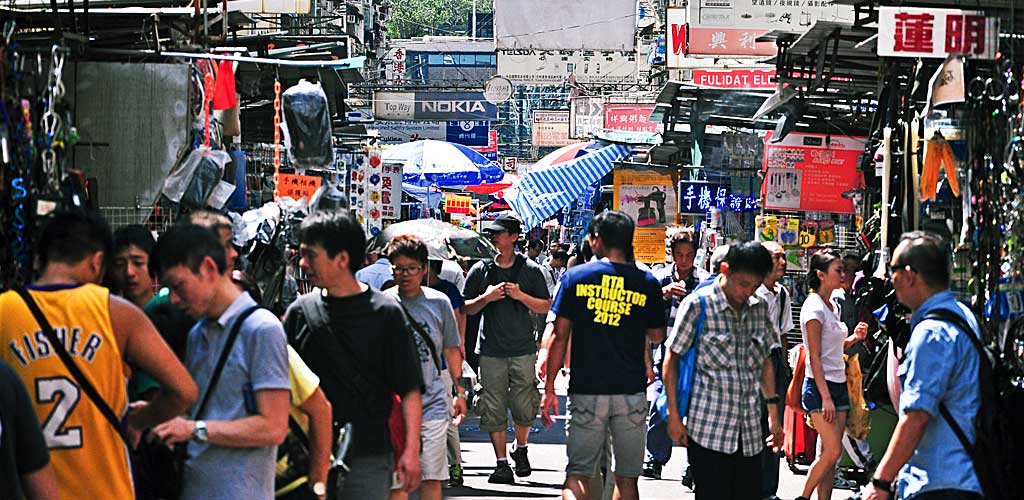
Apliu Street's stalls during trading hours. The photograph is a daytime shot; the market trades from noon into the night, and the pedestrian window ends at 9:00 pm.
What Apliu Street's evening actually is
Apliu Street is one of Sham Shui Po's part-time pedestrian streets, closed to vehicles between 12 noon and 9:00 pm daily. The Transport Department put the district's pedestrian schemes on trial from October 2001 and made them permanent in May 2002 with the support of the Sham Shui Po District Council, with a further set of streets made permanent in June 2004. The road is closed to traffic for those nine hours because of the crowd: the Department states that “at Apliu Street, the pedestrian volume exceeds 5,500 numbers per hour at peak”, and its stated reasoning is that there is insufficient road space to accommodate both vehicles and pedestrians.
The market is not a separately ticketed or separately scheduled event. It is the street, with the stalls working the pavement, and the Hong Kong government's film location library — which catalogues Apliu Street for filming — describes its trading day this way: “The stalls are generally open from noon till night time.” The same entry records the section between Yen Chow Street and Nam Cheong Street as a part-time pedestrian precinct from 12 noon to 9 pm daily.
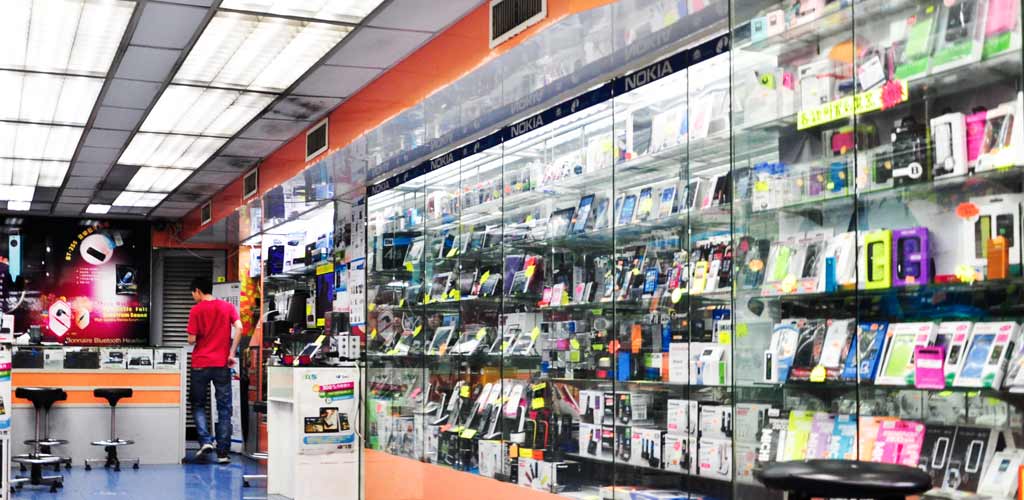
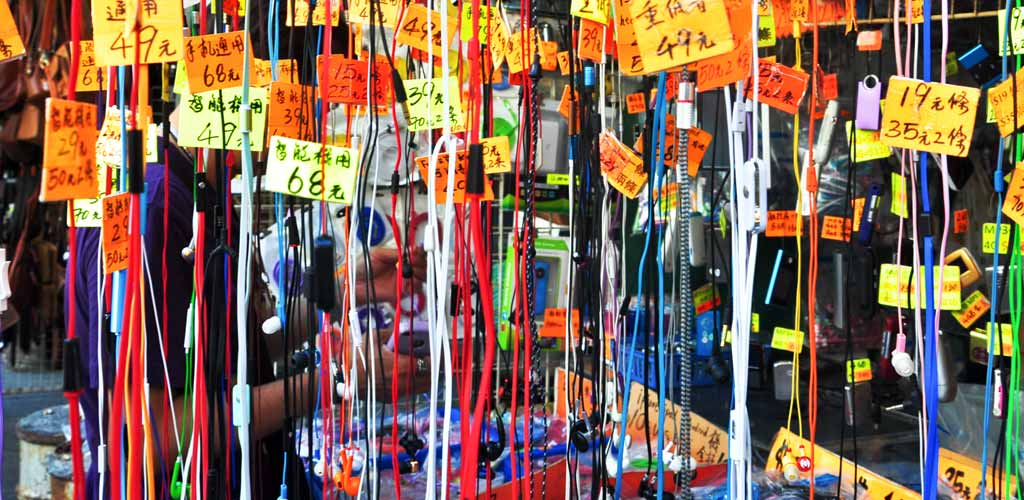
What is on sale is the electronics trade the street is known for. The government's “Hong Kong Fun in 18 Districts” listing places the Apliu Street Flea Market in the section between Nam Cheong Street and Kweilin Street, and describes a cluster of shops and stalls selling brand-new or second-hand electronic parts, electrical appliances, and video and audio equipment, plus watches, antique clocks and old coins. The same picture comes from the government's film location entry: electronic spare parts, electrical devices, hi-fi equipment and tape recorders, much of it second-hand, alongside the cheap watches, antique clocks and old coins the street is known for. An evening visit is simply that market, at the end of its day.
How it compares with Hong Kong's real night markets
The honest comparison is this: Apliu Street does not run a night bazaar. There is no evening-only set of stalls, no scheduled night market and no second shift of traders who arrive after dark. The street trades from noon onwards and finishes in the evening.
Hong Kong's night markets are a different thing, and the site's own Hong Kong flea markets guide sets out how Apliu Street compares with Temple Street Night Market, Ladies' Market and the rest, including their own hours. This page does not repeat those hours; it is only about what Apliu Street itself is like after dark.
Put the two side by side and the choice is straightforward. Choose a night market if the night-market experience is the point of the trip. Choose Apliu Street for electronics, components and second-hand gear — and if Apliu Street is the one you want, come earlier in the evening rather than later.
The timing that works
Arrive inside the pedestrian window. Between 12 noon and 9:00 pm the road is closed to vehicles, which is when the street works as a market you can walk down rather than a road you have to dodge. That window is the street's own working day, and it is the anchor to time a visit around.
Within the window, the later part of the evening is the wind-down, not the build-up. The vehicle ban ends at 9:00 pm, and this is a market that finishes late in the day rather than one that starts then; if you want the stalls still working, plan the visit for the earlier part of the window. For the street's own account of how its hours vary through the week, see Apliu Street opening hours.
One caution, stated plainly: this page gives no vendor closing time, because there is no official source for one. The two official statements about Apliu Street's trading day are the 12 noon–9:00 pm pedestrian window and the description of the stalls as “generally open from noon till night time”. Any other clock time is not a published hours of business, and individual stalls keep their own hours.
Getting home after dark
Apliu Street sits on top of the MTR: Sham Shui Po Station on the Tsuen Wan Line, with Exit C1 coming up onto the street itself. The journey home after an evening visit is therefore a single train line rather than a walk to a transport hub, and the Apliu Street travel guide covers the exits, the bus routes and the route from the airport.
The one thing to plan around is the end of the pedestrian window at 9:00 pm, when vehicles return to the road. On the trains themselves, this page does not quote a last-train time: those change with the day, and the only reliable source is the operator's own page. Check the MTR first and last train times for the station on the day you are travelling.
If a rainstorm or typhoon warning is up
Apliu Street is an outdoor market on an open street, so an evening visit depends on the weather in a way that a mall visit does not. Two Hong Kong Observatory warning systems matter in the rainy season, which the Observatory puts at April to September, with rain often at its heaviest and most persistent during May and June.
Rainstorm warnings come in three levels, defined by hourly rainfall: Amber for heavy rain exceeding 30 millimetres in an hour, Red for exceeding 50 millimetres, and Black for exceeding 70 millimetres. For the Black signal, the Observatory's own advice to the public is to stay indoors or take shelter in a safe place until the heavy rain has passed.
Tropical cyclone warning signals — Nos. 1, 3, 8, 9 and 10 — warn of the threat of wind from a tropical cyclone, and are issued separately from the rainstorm warnings. No. 1 means a tropical cyclone is centred within about 800 kilometres of Hong Kong and may affect the territory. No. 8 means gale or storm force wind, with sustained speeds of 63–117 km/h, is blowing or expected to blow generally near sea level. Tropical cyclones normally occur between May and November, and the Observatory's 1991–2020 climate normals show the signal days concentrated in the summer months.
What this page cannot tell you is what any individual stall does when a signal is up. The Observatory's warnings are public-safety advice, and there is no published source for how vendors on Apliu Street respond to them — so no claim is made here that stalls close or stay open under a given signal. Check the Observatory's latest warnings before you set out.
Practical notes for an evening visit
- Bring cash for the stalls. A street stall is not the place to discover that your usual payment method is not accepted, and carrying enough for what you plan to buy keeps the haggle simple.
- Take a power bank if you are testing gear. Testing a second-hand device before you pay is the whole game on this street; see how to buy safely at Apliu Street.
- Expect the crowd to be the reason the street is pedestrianised. Footfall at Apliu Street exceeds 5,500 people per hour at peak, which is why vehicles are kept out at all.
- Dress for a street, not a mall. The market is outdoors, the pavement is uneven in places, and in the rainy season it is worth knowing which indoor arcade is nearest before the sky opens.
The one-minute version
- Apliu Street is not a night market: it is a market street that runs from noon into the night and winds down in the evening.
- Closed to vehicles 12 noon–9:00 pm daily; the stalls are “generally open from noon till night time”.
- Footfall exceeds 5,500 people per hour at peak — the reason the street is pedestrianised.
- Evening plan: come in the earlier part of the window rather than late.
- Getting home: Sham Shui Po Station (Tsuen Wan Line), Exit C1 onto the street; check MTR's own first and last train times for the day.
- Weather: rainstorm Amber / Red / Black (30 / 50 / 70 millimetres in an hour) and tropical cyclone signals Nos. 1, 3, 8, 9 and 10 are issued by the Observatory — check before you go.
Further reading on Apliu Street
- Apliu Street opening hours — the street's own account of its hours and the pedestrian window.
- The Apliu Street flea market — what is sold on the street, stall by stall.
- How to get to Apliu Street — MTR exits, buses, and the route from the airport.
- Hong Kong flea markets guide — how Apliu Street compares with Temple Street Night Market and Ladies' Market.
- Sham Shui Po district guide — where to eat and what else to see nearby.
- Apliu Street map — the street's location and layout.
Official sources used on this page
- Transport Department — Pedestrian Schemes for Sham Shui Po (part-time pedestrian streets 12 noon–9:00 pm daily; pedestrian volume exceeding 5,500 per hour at peak).
- Create Hong Kong, Film Promotion and Facilitation Section — Apliu Street location library entry (“The stalls are generally open from noon till night time”).
- Government of the Hong Kong SAR — Apliu Street Flea Market, Hong Kong Fun in 18 Districts.
- Hong Kong Observatory — Rainstorm Warning System.
- Hong Kong Observatory — Considerations for issuing tropical cyclone warning signals (signal definitions).
- Hong Kong Observatory — Monthly meteorological normals for Hong Kong, 1991–2020.
- MTR Corporation — First and last train times.