Buying Electronics Safely at Apliu Street
Apliu Street puts genuine new stock, used gear and repair work on the same pavement, so the difference between a good buy and a bad one is usually decided in the two minutes before you hand over cash. This page is about shopping the street with your eyes open: how to tell counterfeit goods from legitimate parallel imports, what to check at the stall, and exactly who to contact in Hong Kong if what you bought turns out to be fake.
⚠️ A note on what this page is not saying
Nothing on this page alleges that any particular shop, stall or hawker on Apliu Street sells counterfeit goods, and nothing here characterises the street as a whole. Apliu Street is a long-established second-hand and electronics market. The point of this guide is shopper protection: what the law requires of sellers, what to check before you pay, and where to go if something is wrong. Everything stated about Hong Kong law and enforcement on this page is taken from the official sources listed at the bottom.
What is legal and what is not: counterfeit goods vs parallel imports
Two very different things get talked about as "fakes" at a market like this one, and they carry different legal weight.
Counterfeit goods are goods, or goods in packaging, carrying a forged trade mark — product presented as a branded item it is not. Under Hong Kong law that is squarely illegal. The Customs and Excise Department states plainly that "any person who sells or possesses for sale any goods with a forged trademark commits an offence". There is no version of a counterfeit deal that is a legitimate bargain; the item is not what it claims to be. One detail from the Consumer Council is worth knowing on a second-hand street: the false trade description offence applies only "in the course of trade or business", but the forged trade mark offence carries no such restriction, so a private individual who sells a counterfeit item to another individual is caught by it as well.
Parallel imports, also called grey imports, are a different matter. These are genuine branded goods that reached Hong Kong through a channel other than the brand's official local distributor. Treat the following as general guidance rather than as a statement of law, because the legal line that matters is genuineness rather than the supply channel: goods sold this way are generally treated in Hong Kong as legal when they really are the genuine article, but they may not come with the brand's local official warranty. That is a warranty question, not a counterfeiting question, and it is a good reason to ask about the warranty before you ask about the price.
The third piece of the puzzle is the description itself, because that is what the law actually regulates. The Trade Descriptions Ordinance (Cap. 362) is the statute the Customs and Excise Department enforces, and the point of it is that what the seller says about an item has to be true. That covers more than a fake logo: a replacement part sold as original, a used unit sold as new, or a capacity or specification stated wrongly can all be a false trade description. The offences and penalties are set out further down the page.
So the useful question at a stall is not "is this cheap?" but "does everything said about this item — on the box, on the price tag, and out of the seller's mouth — match the item itself?"
Red flags at the stall
None of these is proof of anything on its own, and a good seller can be having a bad day. But each one is a reason to slow down, and several together are the moment to walk away.
- The price is far below everything around it. Compare against the neighbouring stalls and against what the same model goes for elsewhere in the city — our price comparison guide sets out how the street, the computer centres and the malls differ. If one stall is asking half what the next stall asks for the same model, either something about the item is different or the item is not what it is presented as. Ask which it is, and watch whether the answer changes.
- The seller will not let you see it running. "Battery's flat, no charger here, it works, trust me" is the most reliable warning sign at any electronics market. A working device takes seconds to demonstrate.
- The numbers do not match. Model number, serial number and IMEI should agree across the device, the box, the settings screen and the receipt. A mismatched serial, an unreadable one, or a box for one model containing another is a hard stop.
- The packaging looks reproduced. Photocopied manuals, labels with the wrong typeface, misspelt brand names, seals that have clearly been re-applied, packaging with no serial and no regional information. Look at the box before you look at the device: it is cheaper to walk away from a bad box than from a device you have already fallen for.
- Only a "shop warranty" is on offer. A shop warranty is the seller's own promise, not the manufacturer's, and a claim on it may depend on proof of purchase from that specific importer. That is worth having, but it is a weaker instrument than the manufacturer's warranty, and it is only ever worth what the shop is still there to honour. Ask which warranty is being offered, in writing, before you talk about price.
- Nothing identifies the seller. No shop name and address on the receipt, no company name at the stall, cash only, and no willingness to put anything in writing. You are not buying a warranty there; you are buying the item and nothing else.
Before you pay: five checks that take ten minutes
These are the same checks in a fixed order. Doing them in this order means you never have to argue about a fault after money has changed hands.
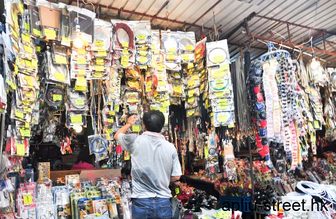
- Test the device in front of the seller, before you discuss price. Power it on, check the settings screen for the model and serial number you were quoted, test the ports, the camera and the speakers and, for a phone, a call and a data connection. For a laptop or console, check that it boots to a working system rather than a demo screen.
- Match the paperwork to the item. Device, box, receipt and price tag should all carry the same model and serial or IMEI. Photograph all four before you leave the stall.
- Check authenticity with the brand owner or its authorised agent. This is the Customs and Excise Department's own advice to consumers, and it is the only check that settles the question rather than narrowing it. A serial-number check with the manufacturer or its Hong Kong agent costs you a few minutes and is worth far more than any visual inspection.
- Buy from reputable shops, and look for Quality Tourism Services (QTS) Scheme accreditation. The QTS Scheme is administered by the Hong Kong Tourism Board, and accredited establishments must pass annual assessments, which include displaying prices clearly. Accreditation is not a guarantee about any individual item, but it is a public commitment to how the shop trades, and it is checkable.
- Get a receipt that would survive a dispute. Shop name and address, a description of the item with its serial or IMEI, the price, the date, and who honours the warranty and for how long. Keep the packaging until you have tested the item at home, and photograph the stall front on the way out. If you later need Customs or the Consumer Council, those photographs and that receipt are the whole of your case.
Two habits are worth more than any of the above: ask the questions before you start negotiating, and be willing to leave. There is always another stall, and a seller who senses you are committed has no reason to answer anything.
Your rights under Hong Kong law
The statute is the Trade Descriptions Ordinance (Cap. 362), and it is enforced by the Customs and Excise Department. Its purpose is to protect consumers by prohibiting false trade descriptions, and false, misleading or incomplete information and misstatements in respect of goods provided in the course of trade. The core offence is applying, supplying, or possessing for sale goods with a false trade description in the course of trade. Selling or possessing for sale goods bearing a forged trade mark is also an offence.
📜 Penalties on conviction under the Trade Descriptions Ordinance
On conviction on indictment: a fine of HK$500,000 and imprisonment for 5 years.
On summary conviction: a fine of HK$100,000 and imprisonment for 2 years.
These are the maximum penalties for the offences; what a court imposes in any individual case is a matter for the court. Do not expect a particular outcome, and do not rely on any promise about what a prosecution would produce.
This law is used. Between 26 May and 19 July 2026, in an operation codenamed "Clean Sheet", Hong Kong Customs detected 50 related cases and seized about 240,000 items of suspected counterfeit goods. Electronics are squarely within that enforcement picture. In a separate case, Customs announced on 9 July 2026 that an operation on 7 July 2026 had seized about 5,400 items of suspected counterfeit goods — mobile phones and other electronic devices — with an estimated market value of about HK$6 million, and that three people had been arrested.
One thing worth understanding before you need it: prosecution and getting your money back are two different tracks. Customs enforces the criminal law against the seller. Recovering what you paid is a separate, civil matter — which is why the rest of this page is about keeping evidence and knowing which door to knock on.
If it goes wrong: who to contact
Three official routes, in the order most shoppers end up using them.
📞 Customs and Excise Department — suspected counterfeit goods
If you believe you have been sold counterfeit goods, report it to Hong Kong Customs:
- 24-hour hotline: 182 8080
- Email: [email protected]
- Online form: eform.cefs.gov.hk/form/ced002/en/
Have the seller's name and location, the date and time, the item, what you paid and the receipt ready. Customs investigates suspected contraventions of the Trade Descriptions Ordinance, so what they need is a description of what was sold to you and by whom — not a general complaint about the market.
🤝 Consumer Council — complaints and conciliation
The Consumer Council is a statutory body under the Consumer Council Ordinance (Cap. 216). Its functions include receiving and examining complaints and giving advice to consumers of goods and services, and it mediates disputes between consumers and suppliers. If you want the shop to put something right — a refund, a replacement, a repair — this is usually the first door.
File the complaint at consumer.org.hk. Keep the receipt, the photographs and any messages from the seller: a complaint with evidence moves, and a complaint without it does not.
⚖️ Small Claims Tribunal — when the shop will not pay
The Small Claims Tribunal deals with monetary claims not exceeding HK$75,000. Hearings are informal and no legal representation is allowed, which is rather the point of the tribunal: you present your own case.
Where: 3/F, Tower B, West Kowloon Law Courts Building, 501 Tung Chau Street, Sham Shui Po.
Hotline: 2877 4068
It sits in Sham Shui Po itself, and it is the route for a claim worth more than a shrug and less than a lawyer.
The one-minute version
- Counterfeit goods are illegal in Hong Kong; genuine parallel imports are not, but they may lack the local official warranty.
- Test the device in front of the seller, match the serial numbers, and check authenticity with the brand or its authorised agent.
- Take a receipt with a shop name, address and the item's serial, and photograph everything before you leave.
- Sold a fake? Customs on 182 8080, or [email protected].
- Want the shop to put it right? The Consumer Council, on consumer.org.hk.
- Want the money back and the shop will not pay? The Small Claims Tribunal, up to HK$75,000.
Further reading on Apliu Street
- The Apliu Street flea market — what is actually sold on the street, stall by stall, and how the market day works.
- Hong Kong electronics price comparison guide — how street-market prices compare with computer centres and malls, so you know what "far too cheap" means.
- Apliu Street repair technicians — what can be fixed, what should be replaced, and how to judge a repair quote.
- Apliu Street opening hours — when the stalls are fully open, and why early morning is a bad time to shop.
- The street itself — where Apliu Street runs, what is at each end, and how it fits into Sham Shui Po.
Official sources used on this page
- Customs and Excise Department — Trade Descriptions
- Hong Kong e-Legislation — Trade Descriptions Ordinance (Cap. 362)
- Customs and Excise Department press release — counterfeit mobile phones and electronic devices seized
- Government of the Hong Kong SAR press release — "Clean Sheet" operation
- Consumer Council — About the Consumer Council (Annual Report 2024-25)
- Consumer Council press release, 15 June 2023 — online second-hand platforms: rights and responsibilities
- Hong Kong Judiciary — Small Claims Tribunal
- Hong Kong Tourism Board — Quality Tourism Services (QTS) Scheme